Blog
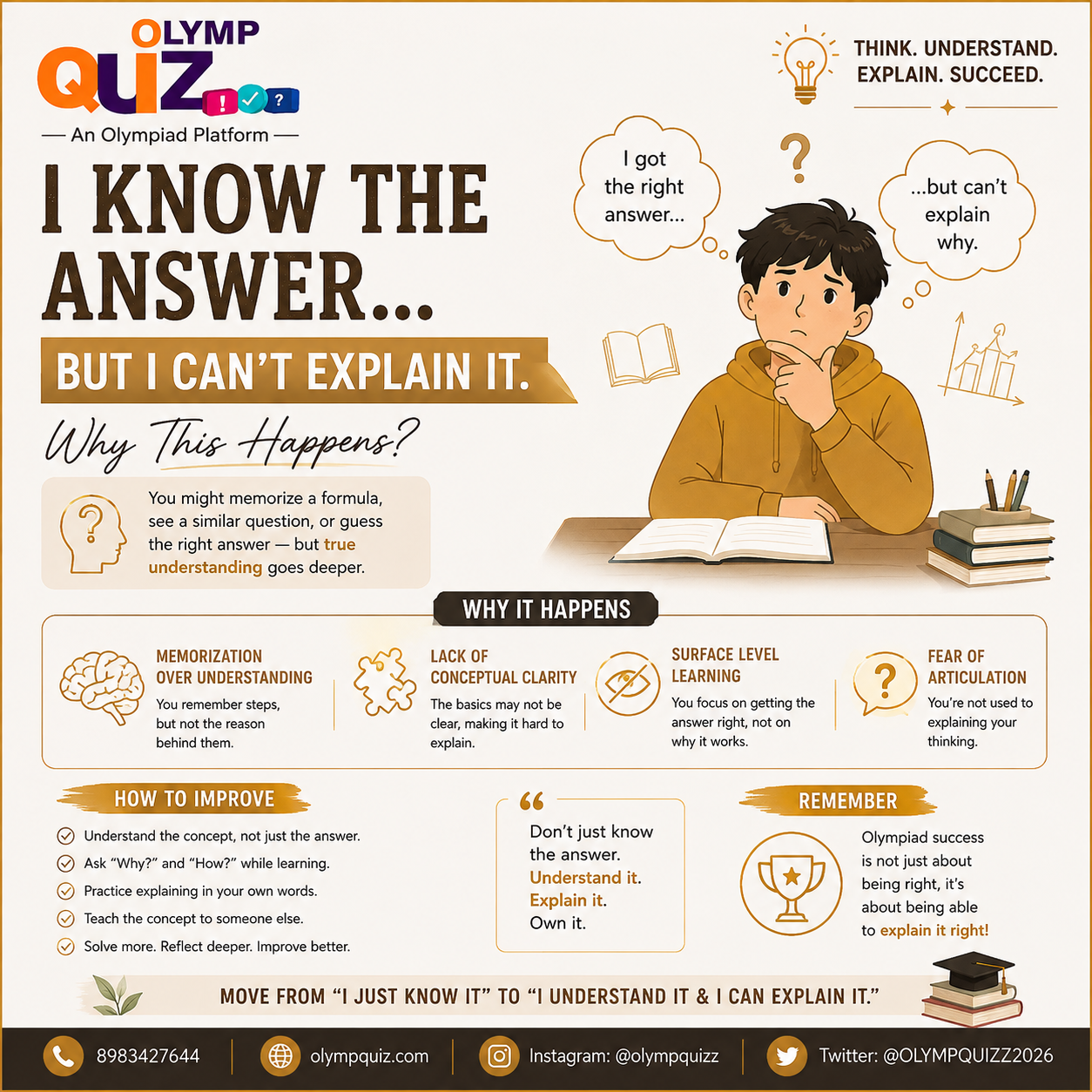
“I Know the Answer… But I Can’t Explain It.” Why This Happens
Have you ever been asked a question in class and thought, _“I know this!”_?
You are sure that you have seen the answer before. You may even be able to choose the correct option in a test. But when your teacher asks, **“Can you explain why?”**, suddenly you are stuck.
This happens to many students.
It does not always mean that you do not understand the topic. Sometimes, it means that you have **remembered the answer without fully understanding the idea behind it**.
This small difference between _knowing_ and _understanding_ can make a big difference in learning.
#### **Knowing an Answer and Understanding It Are Differen**t
Suppose a student is asked:
#### **“Why does ice float on water?”**
The student may remember the answer: _“Because ice is less dense than water.”_
That's correct.
But if we ask:
#### **1\. We Often Focus on the Answer**
When preparing for an examination, it is tempting to remember important definitions, formulas, and answers.
There is nothing wrong with memorising important information. In fact, memory is an important part of learning.
The problem begins when memorisation becomes the **only method of learning**.
A student may remember _what_ happens without understanding _why_ it happens
#### 3\. We Don't Always Ask “Why?”
One simple word can change the way we learn:
**Why?**
Why does this formula work?
Why does this happen?
Why is this answer correct?
Why can't the other answer be correct?
Asking these questions takes a little more effort, but it helps connect different pieces of information.
#### Understanding Becomes Clearer When You Explain
One of the simplest ways to check whether you really understand something is to **explain it in your own words**.
You don't need complicated vocabulary.
Imagine you have learned about photosynthesis. Instead of repeating a textbook definition, try explaining it as if you were teaching the concept to a younger student.
If you can explain the main idea clearly and answer simple follow-up questions, you probably understand it well.
If you keep going back to the exact textbook wording, it may be worth revisiting the concept.
#### What If You Make a Mistake?
This is where many students become nervous.
They think:
“If I don't know the answer immediately, I'm bad at the subject.”
That's not true….
Getting stuck on a difficult question is a normal part of learning.
In fact, difficult questions can show you **where your understanding needs more work**.
Instead of simply checking the correct answer, ask yourself:
* Where did I get confused?
* Which part of the concept did I miss?
* Could I solve it using another approach?
* Can I explain the correct answer in my own words?
A mistake becomes much more useful when you learn something from it.
#### **How Can Students Move From Memorising to Understanding?**
A few simple habits can make a difference.
#### **Try the “Explain It” Test**
After studying a topic, close your book and explain the concept aloud.
If you can explain it naturally, that's a good sign.
If you get stuck, open your notes, review the confusing part, and try again.
#### **Change the Question**
Don't practise only questions that look exactly like the examples in your textbook.
Try different types of questions based on the same concept.
This helps you learn how to **apply knowledge instead of simply recognising it**.
#### **Connect It to Everyday Life**
Whenever possible, connect a concept to something you already know.
For example, Mathematics can be connected to shopping and budgeting, Science to everyday observations, and English to communication.
When knowledge has a connection, it becomes easier to remember and understand.
#### **Teach Someone Else**
Try explaining a topic to a friend, sibling, parent, or even yourself.
You may be surprised by how quickly you discover which parts you actually understand and which parts you need to revise.
---
#### **This Is Where Olympiad Learning Can Help**
Olympiad examinations often encourage students to look beyond straightforward textbook questions.
A question may require students to identify a pattern, apply a concept, compare possibilities, or use logical reasoning to reach an answer.
For example, instead of simply asking students to recall a formula, a question may present a new situation where they need to decide **how and when to use it**.
This kind of practice encourages students to think rather than simply remember.
Olympiads are therefore not just about getting more questions right. They can also help students become comfortable with **thinking through unfamiliar problems**.
#### **Learning Beyond the Answer**
At **OlympQuiz**, we believe that meaningful learning goes beyond memorising answers. Our Olympiad examinations for **Classes 1–10** in **Mathematics, Science, English, Computer, and General Knowledge**
encourage students to strengthen conceptual understanding, logical reasoning, and problem-solving skills.
Because the best question is not always:
**“What is the answer?”**
Sometimes, it is:
**“How do you know?”**
📞 **8983427644**
🌐 [OlympQuiz](https://olympquiz.com/?utm_source=chatgpt.com)
📧 **olymquizz@gmail.com**
.
Copyright | Olymp Quiz. All Rights Reserved